
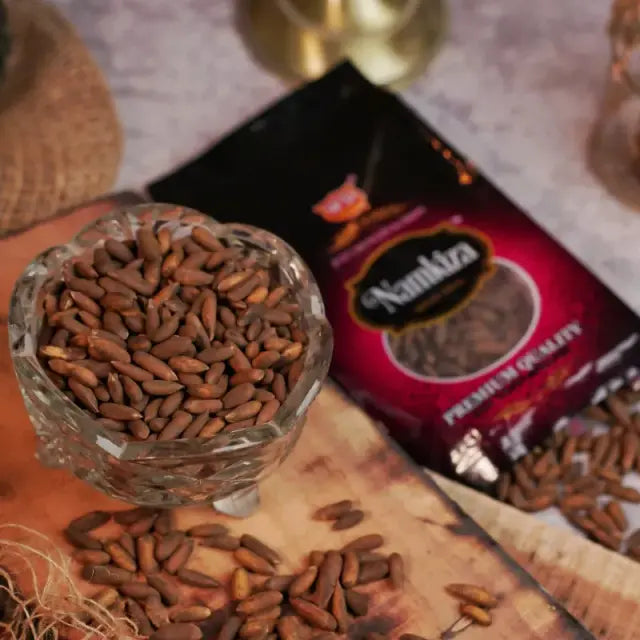
Nobody walks up to my counter and asks for a kilo of chilgoza. They ask for 250 grams, and even that comes with a pause, because at Rs 8,400 a kilo this is the most expensive traditional dry fruit on our shelves. The full rate at WD Foods is Rs 2,100 for 250g, Rs 4,200 for 500g and Rs 8,400 for 1kg, taken from our own product page on 30 October 2026. People assume the shopkeeper is simply taking a fat margin on a luxury item. I used to think the same thing, years ago, before I saw what happens between a pine forest in Waziristan and a packet on my shelf. Almost every hand this nut passes through has a hard job, and almost every step throws most of the weight away.
What you are actually holding
Chilgoza is the seed of the chilgoza pine, Pinus gerardiana, a tree that grows wild in dry mountain forests roughly 1,800 to 3,350 metres above sea level. Nobody plants orchards of it. The forests stand across North and South Waziristan, which together produce an estimated 80 to 85 percent of Pakistan's crop, with more in Zhob and Sherani on our side of Balochistan, and smaller amounts in Chitral and Gilgit Baltistan. The nut itself is long and slim, about 2 to 2.5 centimetres, with a thin shell you crack to reach a pale kernel that tastes rich, oily and faintly sweet. A handful is a serving. Nobody eats chilgoza by the bowl, and at this price, nobody needs to.
The arithmetic of a pine cone
Start with the tree. Forestry department figures put the average yield of an adult chilgoza pine at about 1.8 kilograms of nuts a year. Read that again. One tree, one year, less than two kilos. The tree is also in no hurry: it takes decades to reach full bearing, so when prices rise, farmers cannot simply plant more and answer the demand next season.
Then the harvest. The cones ripen in September and October, high on tall trees, on steep ground. Men climb and cut the cones down one by one, and the cones are carried out of the forest on foot or by animal. Back in the village the cones are dried and heated so the scales open, and the seeds are picked out by hand. A room full of cones becomes a sack of nuts, and a good part of that sack is still shell. Slow tree, tiny yield, hand work at every step. That is the first half of the price, and no trader invented it.
Then the export buyers take most of what is left
The second half of the price arrives by truck from the other direction. According to China's customs figures, Pakistan's pine nut exports to China nearly doubled between 2023 and 2025, from about 580 tonnes to about 1,147 tonnes, worth roughly 17.9 million dollars in 2025. Traders estimate that 80 to 90 percent of everything Pakistan exports now goes to China, where buyers prize this exact nut for its thin shell and mild flavour. So the local shopkeeper is not bidding against other local shopkeepers. He is bidding, at one remove, against the Chinese premium market. What reaches a retail shelf in Quetta or Lahore is what that market did not take, and winter makes it tighter, because demand here peaks from November to February while no new crop exists until the next autumn.
So what should a kilo cost?
Grade matters with chilgoza more than with any other dry fruit I sell, so treat any single number, including mine, with suspicion until you know what grade it buys. Traders quoted general retail in Islamabad between Rs 4,500 and Rs 8,000 a kilo for the 2025-26 season, with export quality fetching up to Rs 12,000. The named online stores sit at the top of that band: Khan Dry Fruits lists its export quality chilgoza at Rs 10,800 a kilo and its Bannu stock at Rs 12,000, while Organic and Pure sells at Rs 11,500 a kilo. Our Rs 8,400 is below those, and I will tell you plainly what it buys: full sized, graded nuts of the current season, checked pack by pack, not the very top export selection.
| Option | Price |
|---|---|
| WD Foods chilgoza, 250g | Rs 2,100 |
| WD Foods chilgoza, 500g | Rs 4,200 |
| WD Foods chilgoza, 1kg | Rs 8,400 |
| General retail, Islamabad traders, by grade | Rs 4,500 to 8,000 per kg |
| Khan Dry Fruits, export quality | Rs 10,800 per kg |
| Export quality, top of the market | up to Rs 12,000 per kg |
One warning I give my own customers. If someone offers you chilgoza far below the going band, ask hard questions. The usual explanations are old stock, mixed sizes, or black chilgoza sold quietly under the plain name. Black chilgoza is the trade name for darker shelled, generally lower grade nuts: smaller kernels, more empties, a cheaper price. Bought knowingly, for cooking, it can be fair value. Bought unknowingly at the pale grade's price, it is how people get cheated in this trade.
How to check a pack in thirty seconds
You cannot taste before you buy in most shops, but you can do four things. Pick up a few nuts: good chilgoza feels full and heavy for its size. Shake one beside your ear: a hollow rattle means the kernel inside has shrivelled to nothing. Look at the colour: pale and fairly even across the pack is what you want. Then smell, because smell settles it. Fresh chilgoza smells mild and clean. A sharp, stale, almost paint like smell means the oils have turned, and at Rs 8,400 a kilo you walk away from that pack whatever the discount. When we check incoming stock at the shop, the smell test rejects more lots than everything else combined.
How to eat it, and how much
Crack the shell gently along its length with your teeth or a small nutcracker and take the kernel out whole. Lean on it and you crush the very thing you paid for. Eat it raw, as it comes. A brief, gentle warming in a dry pan is fine if you like, but real heat dulls the flavour, and this is not a nut you improve by roasting. In the kitchen it is a finishing nut, not a bulk ingredient: scattered over yakhni pulao, set into kheer, folded through a dry fruit garnish where a small amount perfumes the whole dish.
A sensible portion is a small handful, around 30 grams. The nutrition explains both the satisfaction and the restraint. Per 100 grams, chilgoza carries roughly 670 calories, about 13 to 14 grams of protein, around 250 milligrams of magnesium and useful zinc and vitamin E, most of the energy coming from its oils. You may also read that pine nuts suppress appetite because of a fatty acid called pinolenic acid. The honest version: that research was done mostly on pine nut oil, taken in capsules, often from the Korean pine rather than our chilgoza. It is a promising line of study. It is not a promise that a handful after dinner will do the work of a diet. Eat chilgoza because it is one of the great tastes of this region, and let the nutrition be a bonus. And if what you want is a seed for daily eating at a daily price, that is kaddu ke beej, which I have written about in our pumpkin seed guide.
Storing it through a Quetta summer
The same oils that make chilgoza taste this good are what spoil it. Air, heat and light are the three enemies, and a Quetta summer supplies two of them generously. Keep the nuts in an airtight container somewhere cool and dark and they hold well for a few months. For longer keeping, the fridge is the right answer, still sealed tight, because chilgoza picks up the smells of whatever sits near it. The most common mistake I see is the open bowl on the table, refilled for weeks out of generosity. It looks hospitable. It quietly ruins an expensive food. Buy in shell rather than kernels when you can, too: the shell is packaging the tree already paid for, and in shell nuts outlast shelled ones by a wide margin. Our full rate list for the season sits in the dry fruits price list if you want to see what else the winter shelf holds.
Questions I hear most
What is the chilgoza price in Pakistan today? At WD Foods, Rs 8,400 for 1kg, Rs 4,200 for 500g and Rs 2,100 for 250g, checked on 30 October 2026. Around the market, general grades run roughly Rs 4,500 to Rs 8,000 a kilo and export quality up to Rs 12,000.
Why is chilgoza so expensive? A tree gives about 1.8 kilos a year, the cones are cut and opened by hand in remote forests, the season lasts a few weeks, and Chinese buyers now take most of the export crop, nearly 1,147 tonnes in 2025. Small supply, heavy labour, strong foreign demand.
What is black chilgoza? The trade name for darker shelled, lower grade nuts with smaller kernels and more empties. It is a legitimate cheaper option for cooking when it is sold honestly as what it is. Check the smell before buying, as with any grade.
How long does chilgoza stay fresh? A few months in an airtight container in a cool, dark place, and longer in the fridge. If the smell turns sharp or stale, the oils have gone off. Do not eat it, and do not let a discount talk you into it.
Should I buy 250g first? Yes, and I say this against my own interest in selling you a kilo. Start with 250g from any seller, check the size, colour and smell, taste a few, and only then commit. With a nut at this price, the small pack is the cheapest education available.
Buying it from us
WD Foods is the online store of Wahid Nimco, working from Quetta since 1990. Our chilgoza stock sits in the dry fruits collection alongside the rest of the winter shelf, and you can order chilgoza at Rs 8,400 a kilo, delivered across Pakistan in 3 to 5 business days. If you are in Quetta, come to the shop on Masjid Road, open every day from 9 AM to 10 PM, and do the shake and smell test on our stock in front of us before you pay. That is how this nut should be bought.
Written by Syed Azib Anjum for WD Foods, Quetta. We pack and sell this chilgoza ourselves, and this guide is based on the questions our customers ask us most. Prices in this article were checked on 30 October 2026 and can change with the season, so please confirm the current rate on the product page before ordering.
Shop Chilgoza (Pine Nuts) · Browse the dry fruits collection

Written by
Syed Azib Anjum
Marketing Head and Writer at WD Foods
Syed Azib Anjum runs WD Foods, the online store of Wahid Nimco in Quetta, and writes or reviews every guide on this blog. His articles come from daily work with nimko, dry fruits and seeds, and the prices he quotes are checked on the live product pages of this store.

Share:
Papar in Pakistan: Kacha Papar Types, How to Fry Them Right and Prices
Best Nimko Mix for Tea Time: Popular Flavours and Crunchy Snack Options