
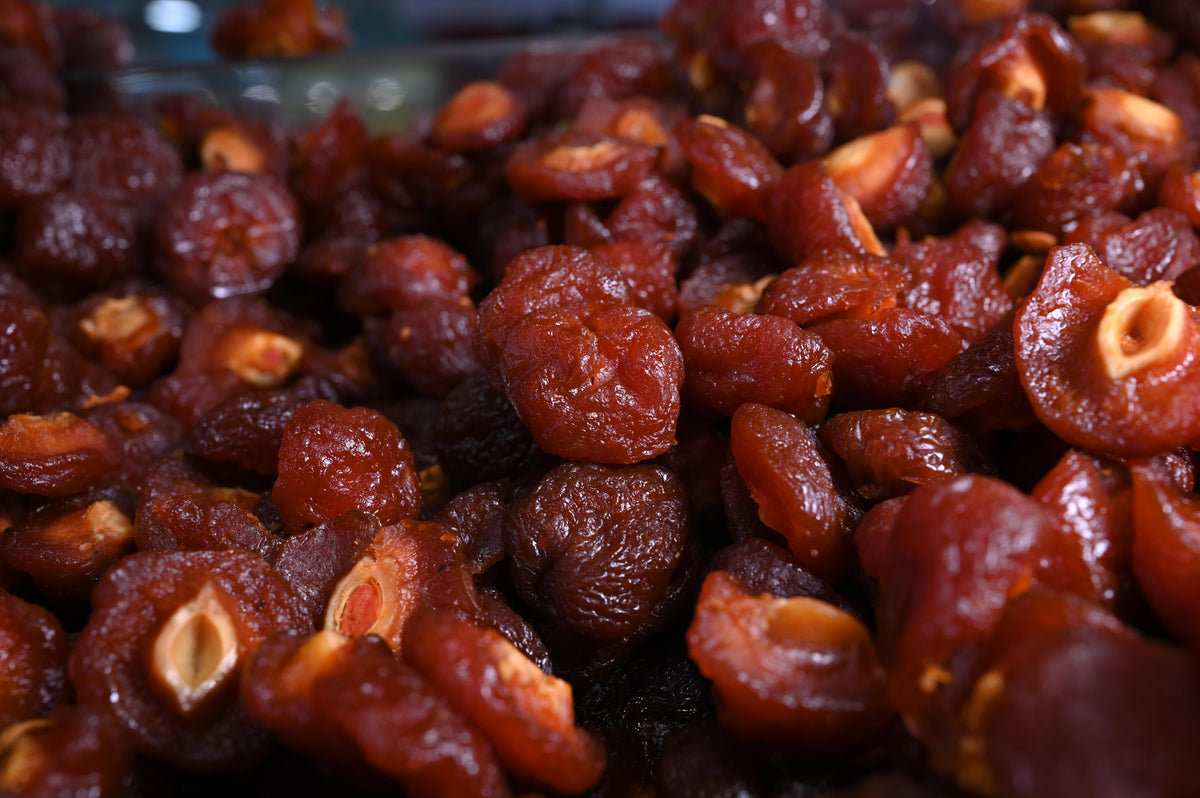
Ask a room of biryani lovers what they hunt for first in the deg and a good number will admit it: the aloo bukhara. That dark, wrinkled, sweet sour plum hiding between the rice is the bite people remember. Khushk aloo bukhara is simply a plum dried whole, with its flavour concentrated into something both tangy and sweet. In English it is a prune, though the desi fruit is usually smaller and sharper than the big imported prunes, and that sharpness is exactly what our cooking wants. At WD Foods it costs Rs 1,100 for 500g and Rs 2,200 for 1kg, taken from our own product page on 30 October 2026.
First, what it is not
Two confusions follow this fruit around. The first is the name: aloo bukhara has nothing to do with aloo the potato. The second is freshness. A fresh plum and a dried plum behave like different ingredients. The fresh fruit is juicy and mild, eaten out of hand in its short summer season. Dried, it turns chewy, deep flavoured and shelf stable, and it goes into the cooking pot. Fresh plums are cultivated across Iran, Pakistan and India, and in our northern areas the harvest is sun dried the way it has been for generations. What you buy from us is that dried fruit, whole, ready for the pot or the jar.
Why the price jumps around so much
Search for aloo bukhara online and you will find a confusing spread. One large store lists a kilo at Rs 800 but shows it out of stock. A health food seller asks Rs 950 a kilo. Hunza sellers work in 300g and 500g packs that price out higher still. Ours is Rs 2,200 a kilo, and rather than pretend that gap does not exist, here is what actually sits behind it. Size is the biggest driver: big, whole, plump fruit costs more than small or broken lots. How dry the fruit is matters too, because a softer, less dried plum carries more water weight and a shorter life, while a properly dried one keeps. And whole fruit with its natural chew is a different product from the pressed, sweetened pieces sold cheaply for snacking mixes.
Judge a lot the way we judge incoming stock. The plums should look dark and full, not shrivelled to the stone. Press one: it should give a little, like a raisin does, not crackle and not feel wet. Smell the pack. Clean dried fruit smells fruity and faintly tart. If it smells of nothing, it is old. If it shines like it has been oiled or sugared, ask why.
Where it earns its place: the kitchen
Biryani and pulao. This is the famous use. Five or six whole plums go into a family sized pot, usually at the layering stage, and they soften into the rice, releasing a gentle sourness that cuts through the oil and spice. A biryani without them is not wrong, exactly. It is just missing the note everyone notices when it is there.
Qorma and meat dishes. A few plums simmered into a mutton or chicken qorma melt down slowly, giving the gravy body and a background tang. It is an old trick in Kashmiri and festive cooking, and it works for the same reason a squeeze of lemon does, only rounder.
Chutney. Simmer the plums with gur, red chilli, salt and a little water until they slump, then blend or mash. That sweet sour chutney is the one served with samosas, pakoras and every fried snack that needs lifting. A batch keeps in the fridge for days.
Sharbat and the morning soak. In summer the plums are soaked and worked into a cooling sharbat, and in many homes a few are simply soaked overnight in water and eaten in the morning, water and all. That last habit connects to the benefit everyone asks about, so let us deal with it honestly.
The digestion reputation, stated carefully
Dried plums are famous for one thing, and the fame is earned. Per 100 grams, they carry roughly 7 grams of fibre and around 732 milligrams of potassium, and they contain sorbitol, a natural sugar alcohol that draws water into the bowel. Fibre plus sorbitol is the pair behind the gentle laxative effect every grandmother already knew about. Eat a few soaked plums in the morning and most people find their digestion runs more regularly. That is a normal food doing a normal job.
What I will not do is stretch that into medicine. The potassium and vitamin K in dried plums are genuinely useful parts of a diet, and research into plums and bone health is interesting, but a plum is not a treatment for anything. Two cautions are worth printing. Dried fruit concentrates natural sugars, so anyone managing diabetes should treat a serving as a small handful, not a bowl. And the same sorbitol that helps at four plums will make itself unpleasantly known at twenty. This is a food where the sensible portion is genuinely small: four to six pieces is a serving, whether they land in your breakfast or your biryani.
Storing it, and a word about the stone
Whole dried plums keep their stone, and for cooking that is normal and fine; the stone comes out easily once the fruit has softened in the pot. If you are eating them as a snack and the stone bothers you, soak the fruit first and it slips out. For storage, an airtight jar in a cool cupboard is enough, and properly dried stock keeps for up to a year. Keep it away from the stove's steam and from strong smells, and check a long stored pack the way you checked it at buying: a little give, a clean fruity smell. Our full season rates for the rest of the shelf are in the dry fruits price list, and if dried fruit is your interest generally, the anjeer guide covers the other great dried fruit of the winter shelf.
Questions I hear most
Are aloo bukhara and prunes the same thing? Yes. Prunes are dried plums, and khushk aloo bukhara is the desi dried plum, typically smaller and tangier than imported prunes. For biryani and chutney, that tang is an advantage, not a defect.
How many should go into a biryani? Five or six whole plums for a family pot of around a kilo of rice. More than that and the sourness starts to bully the dish.
Do I need to soak them before cooking? For biryani and qorma, no, they soften in the steam and gravy. For chutney and the morning eat, soaking first makes them plumper and quicker to work with.
Is aloo bukhara very sour? It is khatta meetha: sweet first, with a clean sour finish. If a lot tastes harsh or fermented, it is not a good lot.
Can I eat it every day? A few pieces daily is a normal, sensible habit for most people. Treat it like the concentrated food it is and it will treat you well.
Buying it from us
WD Foods is the online store of Wahid Nimco, working from Quetta since 1990. You can order khushk aloo bukhara at Rs 2,200 a kilo, delivered across Pakistan in 3 to 5 business days, and the rest of the dried range sits in our dried items collection. In Quetta, the shop on Masjid Road is open daily from 9 AM to 10 PM. Come and press a plum from the pack before you buy it. A good one gives a little. That small test has settled the question at our counter for years.
Written by Syed Azib Anjum for WD Foods, Quetta. We pack and sell these dried plums ourselves, and this guide is based on the questions our customers ask us most. Prices in this article were checked on 30 October 2026 and can change with the season, so please confirm the current rate on the product page before ordering.
Shop Khushk Aloo Bukhara (Dried Plums) · Browse the dried items collection

Written by
Syed Azib Anjum
Marketing Head and Writer at WD Foods
Syed Azib Anjum runs WD Foods, the online store of Wahid Nimco in Quetta, and writes or reviews every guide on this blog. His articles come from daily work with nimko, dry fruits and seeds, and the prices he quotes are checked on the live product pages of this store.

Share:
Best Nimko Mix for Tea Time: Popular Flavours and Crunchy Snack Options