
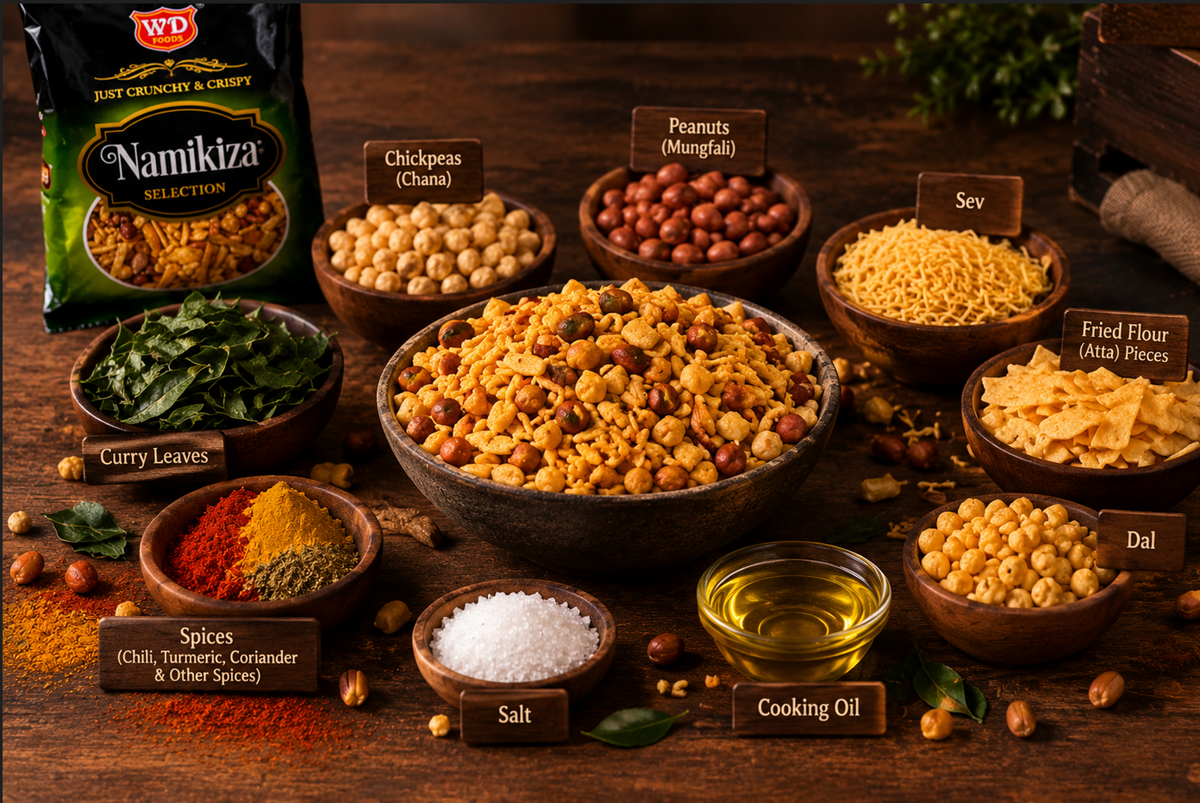
Ask a nimko maker what is in the mix and he will usually wave at the bowl and say, everything. That is not good enough if you are the one eating it, or the one trying to make it at home, so here is the real answer from our side of the counter. A traditional Pakistani nimko mix is built from four families: besan sev in its different thicknesses, fried daals of several kinds, fried chana and peanuts, and one spice mix that ties the whole bowl together. Everything else is variation. Get those four right and you understand every nimko in Pakistan, ours included.

The sev family: the body of the mix
Sev is a dough of besan, gram flour, pushed through a hand press with different discs and fried in strands, and it makes up the largest share of most mixtures. The thickness of the disc decides the name on the tray. Bareek sev is the fine one, almost hair thin, the sev that disappears into chaat and dahi bhallay. Jara sev is a touch thicker and crunchier, the everyday eating sev. Ghatiya is the thick, pillow shaped cousin, soft centred compared to the strands, and the piece children pick out of the mix first. The dough itself is plain: besan, salt, a little turmeric for colour, often a pinch of ajwain, water, and nothing you would not find in any Pakistani kitchen. What separates good sev from sad sev is not the recipe. It is the frying, low and patient, because sev rushed in hot oil colours before it crisps, and sev fried tired stays tired in the bag.
The daals: where the real work hides
Every daal in a mix is its own small project, and this is the part home cooks underestimate. Moong daal is soaked for three to four hours, drained and dried properly, then fried until it turns crisp and pale gold. Whole black masoor, the daal of daal moth, gets the same soak and the same treatment. Chana daal is soaked longer, sometimes with a pinch of soda in the water, and fried to a deeper crunch. Kabuli chana goes in whole for the big satisfying bite. Each one is fried separately, because a pan that suits moong will burn masoor, and each one is salted while it is still warm so the salt holds.
Skip the drying step and you learn why shops guard it. A daal that goes into the oil still damp steams instead of frying, drinks grease, and comes out leathery. That single mistake accounts for most disappointing homemade nimko I have ever been handed to taste, usually by a relative, usually with hope in their eyes.
Peanuts, chana and the sweet guest
Peanuts are fried or roasted and bring the richness that sev and daal cannot. They are also the ingredient that decides a mix's price band, because a mixture generous with peanuts costs real money to fill, and a mixture that hides three peanuts per handful is priced accordingly. Some mixes, ours on request and several Karachi styles by habit, add a small share of kishmish, raisins, which sounds wrong until you eat it: one sweet bite in ten resets your palate and makes the next salty handful taste new again. If you or your children have a peanut allergy, read any mix's label before buying, ours included, and ask us. Peanuts travel through shared fryers in every nimko kitchen in the country.
The spice mix: salt, heat and the sour lift
Now the part that actually carries the signature. A working nimco spice mix, the one in the style Food Fusion published and close to what most Pakistani makers use, is almost embarrassingly simple: for a home batch, about 2 teaspoons of salt and 2 tablespoons of red chili powder ground fine with half a teaspoon of tatri, citric acid. That is the skeleton. Around it, makers adjust: cumin powder for warmth, black salt for depth, a little amchur, dry mango powder, where the tatri runs short, black pepper in the mixes that want a slower heat, and chaat masala sprinkled at the end in the tangier styles.
The order matters more than the list. Chili gives heat, but heat alone is just noise. Salt makes the daals taste like themselves. Tatri is the quiet one: it adds the faint sour finish that makes a bowl of nimko hard to leave alone, and it is the flavour people miss without naming when they eat a mix that was seasoned with chili and salt alone. When customers tell me a homemade batch tastes almost right but not quite, the missing half teaspoon is tatri nine times out of ten.
A working home recipe: daal moth, the maker's way
This is the recipe I give people who insist on trying, built on the classic method. It makes roughly a family bowl.
For the daal: soak 1 cup of whole black masoor for 3 to 4 hours. Drain it, spread it on a cloth and let it dry until no surface water remains. Fry in hot oil in small batches until crisp, then drain and salt lightly while warm.
For the sev: knead 1 and a half cups of besan with salt to taste, a quarter teaspoon of turmeric and about 2 tablespoons of oil, adding water slowly to a soft dough, roughly a quarter cup. Rest it, grease the sev press and your hands, and press the dough through the finest disc you have straight over the karahi. Fry on a low flame until golden and crisp, then lift out and let it cool completely. Sev crisps as it cools, so judge it after five minutes, not in the pan. Break it into short pieces with your hands.
To finish: combine the fried daal and sev, add about 1 tablespoon of the spice mix above, toss gently and taste. Adjust salt before chili, always. Let the whole bowl cool fully before it goes anywhere near a jar.
Why the shop version keeps its crunch longer
People ask why our daal moth, Rs 800 a kilo in the nimko collection, stays crisp for weeks when a home batch softens in days. Three unglamorous reasons. We fry in batches small enough that the oil stays at temperature, so nothing steams. Every component is cooled separately and completely before mixing, because one warm ingredient fogs the whole batch from inside the bag. And the packs are sealed the same day in a dry room, not scooped from an open tray as the week goes on. Do those three things at home and your daal moth will keep far better. Skip any one of them and no recipe, however famous, will save it.

Questions I hear most
What are the main ingredients in nimko mix? Besan sev of one or more thicknesses, fried daals such as moong, masoor and chana daal, fried kabuli chana, peanuts, and a spice mix of salt, red chili and tatri, with cumin, black salt or amchur in some styles. Our full ready made version is the Mix Nimko at Rs 800 a kilo.
What gives nimko its tangy taste? Tatri, citric acid, ground into the spice mix, sometimes helped by amchur or chaat masala. It is a small quantity with an outsized effect.
Can I make nimko without a sev press? For daal moth and daal moong styles, yes: the daals carry the dish and bought sev can stand in, as many home cooks do. For a full mix, the press is the one tool that matters, and a basic one is cheap in any bazaar.
Why did my homemade nimko go soft? Almost always moisture: daal fried while still damp, sev judged hot instead of cooled, or the mix jarred before it reached room temperature. The fixes are in the recipe above, in that order.
Is nimko gluten free? The daals, chana and peanuts are, but sev is besan, which is gram flour and naturally gluten free too. The honest caution is the shared fryer and shared counters in any working nimko kitchen. If the allergy is serious, ask the maker directly. We answer that question at our counter without embarrassment.
Buying it from us
If the recipe sounds like a Sunday you would rather spend eating, the trays are ready: Mix Nimko and Daal Moth at Rs 800 a kilo, the sev family from Rs 500 a kilo, delivered across Pakistan in 3 to 5 business days or over the counter on Masjid Road, Quetta, daily 9 AM to 10 PM. And if you do make your own, bring me the report honestly. The failures teach more than the successes, in nimko as in most things.
Written by Syed Azib Anjum for WD Foods, Quetta. We make and sell this nimko ourselves, and this guide is based on the questions our customers ask us most. Prices in this article were checked on 30 October 2026 and can change with the season, so please confirm the current rate on the product page before ordering.
Shop Mix Nimko · Browse the nimko collection

Written by
Syed Azib Anjum
Marketing Head and Writer at WD Foods
Syed Azib Anjum runs WD Foods, the online store of Wahid Nimco in Quetta, and writes or reviews every guide on this blog. His articles come from daily work with nimko, dry fruits and seeds, and the prices he quotes are checked on the live product pages of this store.

Share:
Nimko Mix Price in Pakistan: Latest Price List 2026
Nimko Mix for Parties: Best Party Packs, Bulk Options & Prices in Pakistan